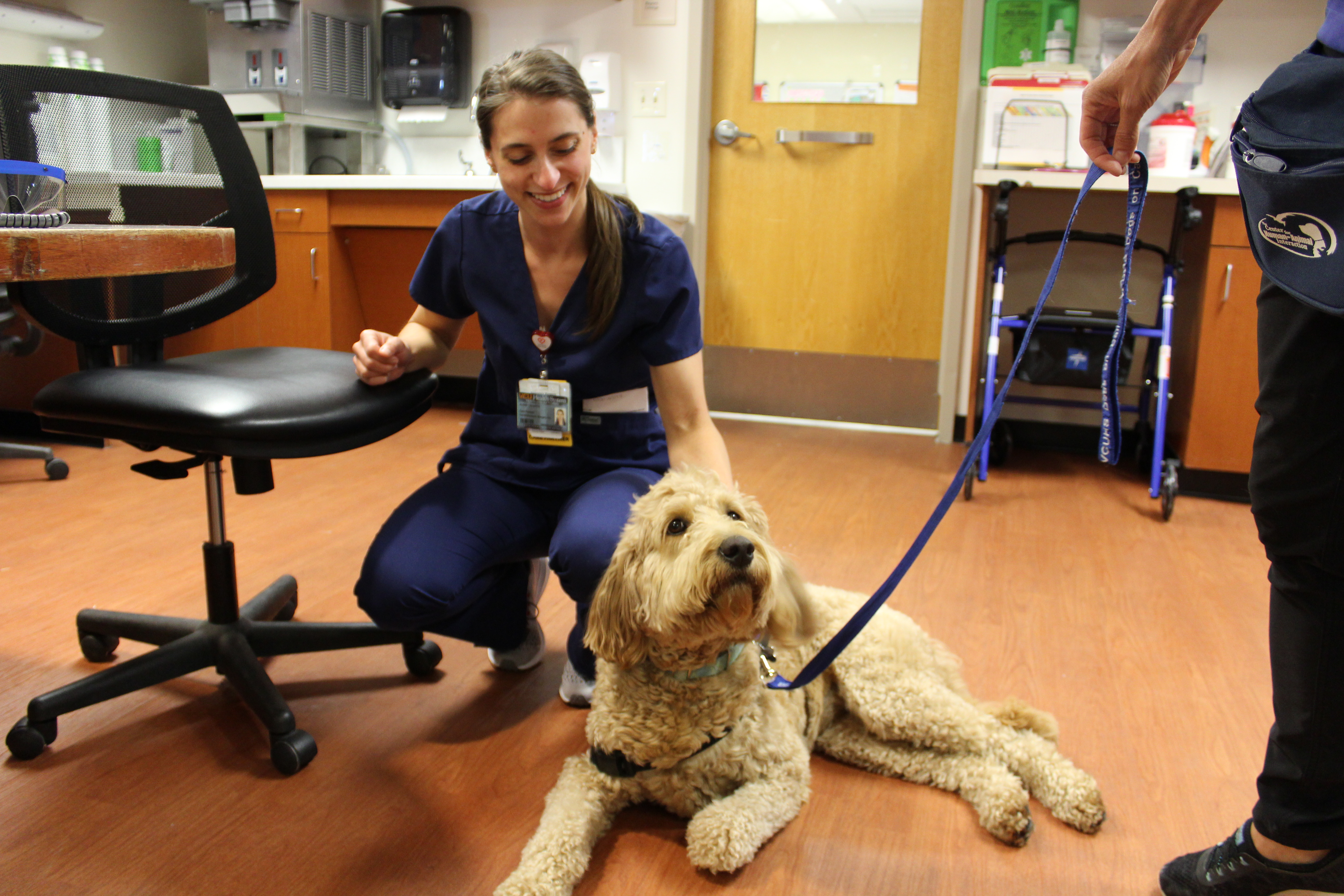
For the past 10 years, Margaret Popik and her goldendoodle, Elsa, have volunteered for VCU’s Dogs on Call program, visiting patients, families and staff at VCU Medical Center as well as students on the MCV and Monroe Park campuses.
Here, she shares her motivation for getting involved and the rewards of being part of a hospital-based therapy dog program.
How did you first get involved with Dogs on Call?
When my son was 7, his best friend was diagnosed with liver cancer. He was getting great care, but his parents said the first time he smiled while in the hospital was when Dogs on Call volunteers came to visit. They sent me all these pictures of Jack and his sister interacting with a dog team, and he was smiling so big. I thought, “I would love to be part of this.” I was a stay-at-home mom at that point, and I missed my work as a school psychologist. I missed the clinical interactions.
Elsa and I spent a year in training classes working on general obedience, impulse control and how to be comfortable in a loud environment. I wanted to make sure she was comfortable and that we were compatible and good for this type of work. We passed our test and started the onboarding process.
Jack subsequently finished his treatment. He just graduated from high school this May, and Elsa and I recently celebrated our decade of service. Elsa’s getting older and is inching toward retirement. I’m not ready to retire, but I honor that my dog is 12 and that she doesn’t have the energy she used to have.
Do you think you’ll volunteer again with a different dog?
I’d love to, but not every dog is cut out for it, and that’s OK. When we get a new dog, I want to make sure that they’re comfortable and happy doing the work. It’s not something you can force on a dog. They have to really love it, too.
Does Elsa love volunteering?
She does! She’s ordinarily a quiet, calm dog, but when I get her special Dogs on Call vest out of the closet, she knows we’re going and she gets very excited. She gets excited again when we drive through the parking garage. She knows exactly where we are.
A handful of people working in the hospital have treats in their offices. We get off an elevator, and she knows what floor we’re on and exactly where to go for those treats.
When we get home, I take off her vest and let her be a dog. She might run around in the backyard, roll around and then nap on a pillow for the rest of the day. It’s a pretty good life for her.
Can you share a meaningful patient interaction?
We’ve spent a lot of time working in pediatrics. If a kid’s in the hospital, they’re usually pretty sick, and they can be scared. It can be hard for them in a way that’s different from grown-ups. Their parents and their families are usually with them, and they’re very stressed and worried. There are a lot of big feelings in the room.
When we walk in, a certain magic happens. I can feel it. I can feel everybody relax. Sometimes not a lot of words are said. I’ve learned that my job is not to make small talk; it’s to let Elsa’s presence be the thing. Sometimes the patients pet her and cry, sometimes they hug her, sometimes the parents cry and sometimes staff members come in to watch the interaction.
One meaningful moment was when we were walking in the hallway and were asked if we could help a child who was resistant to getting a throat swab. She was about to be restrained.
We walked in, and the child asked if Elsa could lie on her bed. The caregivers told the child she would need to stay still so she wouldn’t hurt Elsa. Elsa got up and lay down next to her. The child placed her hand on Elsa’s back, held perfectly still and opened her mouth. They got the swab and could move on. The parents and the care team were so grateful. It was a good feeling.
That sounds gratifying. How does this work impact you?
I can experience the whole gamut of emotions in a session. It’s hard to see people who are suffering, but it’s also joyful to bring them joy.
It’s an honor, really, to be invited into these spaces. It feels sacred sometimes that someone’s willing to let you in when they’re feeling poorly. I don’t take that lightly.
When I first started, I thought I’d have to be all Suzie Sunshine going into a room, but that’s not what feels real. It feels real to let Elsa walk in, rest her chin on their bed and let them do with that what they will.
Dogs on Call relies on donor support to recruit and train volunteer handler-and-dog teams and purchase the supplies they need, like the vest Elsa loves to wear. Make a gift to the VCU Center for Human-Animal Interaction in support of Dogs on Call.